Do they? There’s one thing to make it law, another thing to enforce it. OSA in the UK has been around since last July and managed to do nothing other than pick a fight with 4chan and get nowhere. I seem to recall someone mentioned Lemmy to Ofcom in a discussion regarding OSA and they were literally like “What’s a Lemmy?”
How on earth do you imagine a regulator is going to work out how to deal with 50+ federated instances (for instance)?
I mean if they can really just do nothing, then that is also something it would be good to be sure about.
Nintendo has shown that it is possible to attack open source projects at the repository level, and while that wouldn’t necessarily stop development, it would be a step down to force development technically “underground”.
And if instances have to start being regularly replaced, that WILL cause attrition.
I just think this is a logistical dead-end for regulators who may rely on the chilling effect of the thought of being targeted rather than actually being targeted. Unless the Fediverse somehow becomes massive, I don’t see that it’ll ever enter their eyes. Especially as many places will be based in the USA who is the least likely country to implement these laws, and the most hostile to any threats from foreign regulators (see again the 4chan example).
You may want to look into what the legal requirements actually are, and how it changes who is liable. It is outright draconian.
Essentially, it requires the OS to find out the age of the user, and then inform ALL software that is run by API. Any software that theoretically could use the data, and still allows a child to see something they should not have, will be liable.
You claimed that the US was the least likely to do this sort of thing…
Instead, despite the incompetence, they are clearly spearheading this globally along with the UK. Making it most decidedly the first place that will have to deal with this crap.
Yes, but if the OS was not designed in California and you are not based in California (you’re not Windows, basically) - I fail to see how they can meaningfully compel anyone to follow this. Moreover, even if an OS somehow could know the users age - that doesn’t automatically mean all other software that exists automatically reads it and responds to it as necessary.
Does the law compel anyone making software to recognise this?
Windows, and any other OS will be illegal in California unless it implements this.
Apple, for one, is headquartered in California.
So, the OS wont work until the user verifies their age somehow.
Moreover, even if an OS somehow could know the users age - that doesn’t automatically mean all other software that exists automatically reads it and responds to it as necessary. Does the law compel anyone making software to recognise this?
Did you not read my comment? Anyone writing software for an OS that implements this, can be sued (in California) if their application ignores the API signals from the OS and allows access to age-restricted content.
Or is your argument really “this won’t affect linux, so it doesn’t matter” ? At the very least, FOSS development by anyone in California will be a problem, as the law quite literally names “persons” as potentially liable.
The reality remains, the US is the most thirsty for this kind of thing. Not the least.
Windows, and any other OS will be illegal in California unless it implements this.
Right, as I said - I just don’t see how this is meaningfully enforceable. It’s a complete farce. It’s on the level of the Online Safety Act it being enforceable.
Apple, for one, is headquartered in California.
Oh, I forgot Apple. Sure.
But there are many other OS. How on earth can they credibly enforce this?
Did you not read my comment? Anyone writing software for an OS that implements this, can be sued (in California) if it ignores the API signals from the OS and allows access to age-restricted content.
Yeah, this is just not meaningfully enforceable. Big companies will follow, but it would mostly be ignored by everyone else.
Is your argument really “this won’t affect linux, so it doesn’t matter” ? At the very least, FOSS development by anyone in California will be a problem, as the law quite literally names “persons” as potentially liable.
The reality remains, the US is the most thirsty for this kind of thing. Not the least.
And they are already working on an even more overreaching version that will close loopholes in the current legalese.
Is your argument really “this won’t affect linux, so it doesn’t matter” ? At the very least, FOSS development by anyone in California will be a problem, as the law quite literally names “persons” as potentially liable.
I’m taking the position that this is largely unenforceable at a software and OS level beyond larger players that come from California or specifically do a lot of trade in California.
The reality remains, the US is the most thirsty for this kind of thing. Not the least.
This specifically is quite different to most other efforts. Not sure if it might get constitutionally tested.
I’d like you to realize that “the USA who is the least likely country to implement these laws” is literally the opposite of current reality.
They are making some of the greatest efforts to make legally mandated user and age tracking a thing, as well as legally mandated user identity based content-gating.
I’d like you to realize that “the USA who is the least likely country to implement these laws” is literally the opposite of current reality.
In comparison to Europe/UK/AUS which is far further along this road (and implemented social media age requirements), absolutely. Also, apparently it’s just a checkbox as far as this particular California law goes.
Wikipedia took UK to court over the fear of being targeted, it was dismissed purely on the basis of “Well they haven’t done anything to you yet”. And Ofcom clearly hasn’t got the balls to do it.
PiraHxCx@lemmy.dbzer0.com
on 17 Feb 22:44
nextcollapse
I’m all pro Age Verification, the good old “If you are over 18 click yes”
rants_unnecessarily@piefed.social
on 18 Feb 11:23
nextcollapse
We need old school Leisure Suite Larry age verification questions asking things like, “Where were you on 9/11”, or “What’s George Bush’s middle name’s first letter?”
YiddishMcSquidish@lemmy.today
on 18 Feb 12:54
collapse
If someone is eighteen today, they would’ve been negative eight years old during 9/11.
rants_unnecessarily@piefed.social
on 18 Feb 14:48
nextcollapse
Tough! Better luck with the next question. Luckily it’s best out of 3.
no_circumlocution@lemmy.world
on 19 Feb 20:59
collapse
That depends on if said person means 11 Sep 2001, Sep 2011, or Nov 2009.
FineCoatMummy@sh.itjust.works
on 20 Feb 17:09
collapse
If you are over 18 click yes
Years ago, I heard of a guy who failed one of the voluntary “enter your age” checks because it thought he was 7 years old. He was actually 107, but the system only considered the last two digits.
tehWrapper@lemmy.world
on 17 Feb 22:54
nextcollapse
If I setup my own private instance and don’t make myself verify my age… can they still stop me from following others or other instances following me in some way?
It would only ever be instances specific would it not?
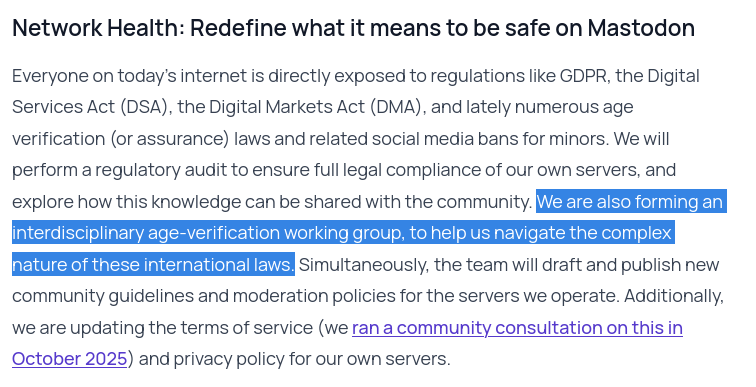
I am failing to see how the highlighted text is saying that they will implement it. My understanding is that they are evaluating yhe situation. Am I wrong?
threaded - newest
I’m not worried. Either it’ll only affect their dedicated servers. Or it’ll be integrated into mastodon itself and then quickly forked.
I mean… They have to.
Countries are making it law, so sooner or later, fedi projects are going to have to deal with that crap.
Do they? There’s one thing to make it law, another thing to enforce it. OSA in the UK has been around since last July and managed to do nothing other than pick a fight with 4chan and get nowhere. I seem to recall someone mentioned Lemmy to Ofcom in a discussion regarding OSA and they were literally like “What’s a Lemmy?”
How on earth do you imagine a regulator is going to work out how to deal with 50+ federated instances (for instance)?
I mean if they can really just do nothing, then that is also something it would be good to be sure about.
Nintendo has shown that it is possible to attack open source projects at the repository level, and while that wouldn’t necessarily stop development, it would be a step down to force development technically “underground”.
And if instances have to start being regularly replaced, that WILL cause attrition.
I just think this is a logistical dead-end for regulators who may rely on the chilling effect of the thought of being targeted rather than actually being targeted. Unless the Fediverse somehow becomes massive, I don’t see that it’ll ever enter their eyes. Especially as many places will be based in the USA who is the least likely country to implement these laws, and the most hostile to any threats from foreign regulators (see again the 4chan example).
uh, what?
Yes? USA is the least likely to do this. Porn laws in various states don’t apply to social media.
Other attempts have been stuck in legislative hell, been unenforced or have court cases challenging their legality (Mississipi)
US Tech firms profit the most from it, the verification data lands on some palantir server - as the recent discord fiasco implied.
Whether they do so optionally is a different thing entirely, to be fair.
Not even two weeks later, California is making OS level age verification a thing.
I’m not even sure how that is remotely enforceable, although this also is a somewhat different thing to what this thread is about.
You may want to look into what the legal requirements actually are, and how it changes who is liable. It is outright draconian.
Essentially, it requires the OS to find out the age of the user, and then inform ALL software that is run by API. Any software that theoretically could use the data, and still allows a child to see something they should not have, will be liable.
You claimed that the US was the least likely to do this sort of thing…
Instead, despite the incompetence, they are clearly spearheading this globally along with the UK. Making it most decidedly the first place that will have to deal with this crap.
Not the last.
Yes, but if the OS was not designed in California and you are not based in California (you’re not Windows, basically) - I fail to see how they can meaningfully compel anyone to follow this. Moreover, even if an OS somehow could know the users age - that doesn’t automatically mean all other software that exists automatically reads it and responds to it as necessary.
Does the law compel anyone making software to recognise this?
Windows, and any other OS will be illegal in California unless it implements this.
Apple, for one, is headquartered in California.
So, the OS wont work until the user verifies their age somehow.
Did you not read my comment? Anyone writing software for an OS that implements this, can be sued (in California) if their application ignores the API signals from the OS and allows access to age-restricted content.
Or is your argument really “this won’t affect linux, so it doesn’t matter” ? At the very least, FOSS development by anyone in California will be a problem, as the law quite literally names “persons” as potentially liable.
The reality remains, the US is the most thirsty for this kind of thing. Not the least.
Right, as I said - I just don’t see how this is meaningfully enforceable. It’s a complete farce. It’s on the level of the Online Safety Act it being enforceable.
Oh, I forgot Apple. Sure.
But there are many other OS. How on earth can they credibly enforce this?
Yeah, this is just not meaningfully enforceable. Big companies will follow, but it would mostly be ignored by everyone else.
Is your argument really “this won’t affect linux, so it doesn’t matter” ? At the very least, FOSS development by anyone in California will be a problem, as the law quite literally names “persons” as potentially liable.
The reality remains, the US is the most thirsty for this kind of thing. Not the least.
And they are already working on an even more overreaching version that will close loopholes in the current legalese.
I’m taking the position that this is largely unenforceable at a software and OS level beyond larger players that come from California or specifically do a lot of trade in California.
This specifically is quite different to most other efforts. Not sure if it might get constitutionally tested.
…
So this is not a concern to you?
The fact that there are people in leadership positions that want this, and have reasons why they want this, is below note. And not worth opposing?
This will lead to infrastructure, that should not exist, existing.
That it can be avoided is not a solution. It should not be built in the first place.
It is a concern, I just don’t know how it’s meaningfully enforceable at scale. Just like OSA. What do you want me to do about it personally?
I never supported the idea.
I’d like you to realize that “the USA who is the least likely country to implement these laws” is literally the opposite of current reality.
They are making some of the greatest efforts to make legally mandated user and age tracking a thing, as well as legally mandated user identity based content-gating.
In comparison to Europe/UK/AUS which is far further along this road (and implemented social media age requirements), absolutely. Also, apparently it’s just a checkbox as far as this particular California law goes.
I’m out of the loop. What happened there?
Probably talking about Nintendos recent re-crackdown on the repos of Switch emulators.
Still waiting for wikipedia to block itself in UK.
Wikipedia took UK to court over the fear of being targeted, it was dismissed purely on the basis of “Well they haven’t done anything to you yet”. And Ofcom clearly hasn’t got the balls to do it.
I’m all pro Age Verification, the good old “If you are over 18 click yes”
We need old school Leisure Suite Larry age verification questions asking things like, “Where were you on 9/11”, or “What’s George Bush’s middle name’s first letter?”
If someone is eighteen today, they would’ve been negative eight years old during 9/11.
Tough! Better luck with the next question. Luckily it’s best out of 3.
That depends on if said person means 11 Sep 2001, Sep 2011, or Nov 2009.
Years ago, I heard of a guy who failed one of the voluntary “enter your age” checks because it thought he was 7 years old. He was actually 107, but the system only considered the last two digits.
If I setup my own private instance and don’t make myself verify my age… can they still stop me from following others or other instances following me in some way?
It would only ever be instances specific would it not?
I doubt they would bother going after a one person instance, even if it could be traced back to you
We shut migratie everything to I2P and Tor.
Should do that anyway tbh
.
Don’t be lawful evil, be neutral good. Or even chaotic good.
I am failing to see how the highlighted text is saying that they will implement it. My understanding is that they are evaluating yhe situation. Am I wrong?